


Still using Excel for ESG reporting? Here’s why that’s a risk


ESG reporting in Excel often starts simple - and ends up more complex than expected.
Many companies begin their carbon accounting and sustainability reporting pragmatically in Excel. It is available, flexible, and familiar. For the first steps in ESG reporting or CO₂ management, it seems sufficient.
But ESG is no longer a one-off reporting exercise. With growing requirements around Scope 3, Product Carbon Footprints (PCF), and audits, it is not just the volume of data that increases – it is the complexity. And this is exactly where the structural limits of spreadsheets become apparent.
Andrea Prudenti, Head of Health, Safety, Sustainability and Environment at The Family Butchers, puts it plainly: „At some point, Excel is simply not enough. Manufacturers need software that structures and cleanly processes data."
When decentralized structures meet data volume
MAX Automation SE, a mid-sized industrial group with several independently operating entities across more than ten locations in Europe, Asia, and the US, and around 1,500 employees, had neither systematic CO₂ accounting nor consistent ESG processes before introducing dedicated software. Many workflows were manual and therefore prone to errors. A meeting with the auditor where no CO₂ balance could be presented made clear that action was needed.
„In our decentralized structure, carbon accounting with Excel would not have been possible. Tanso has become a central success factor for us – for control, data collection, and reporting," says Lisa Femerling, ESG Manager at MAX Automation.
The challenge was not collecting the data, but processing it. This is the key difference: Excel collects information. ESG software structures processes.
Managing emission factors and methodologies becomes particularly demanding. These change regularly – sometimes only slightly, but with significant implications for comparability and auditability.
In Excel, this means manually tracking versions, reviewing changes retroactively, maintaining methodology notes separately.
An ESG software platform, by contrast, manages emission factor versions systematically over multiple years, documents methodological changes transparently, and ensures that historical calculations remain traceable.
ESG reporting in Excel: The hidden risk of errors
Many companies estimate error rates of 30–40% in manually created emissions calculations. This is less a reflection of missing expertise – and more a result of the structural limitations of manual tools.
ASSMANN, a manufacturer of modern workplace furniture solutions, began converting environmental metrics into a CO₂ balance as early as 2019. Data management was handled manually in Excel, using emission factors from various databases. This approach was time-consuming and error-prone – and provided no audit security.
Such inconsistencies are only identified if someone notices them. There are no automated plausibility checks, no structured year-over-year comparisons, and no systematic alert mechanisms.
This highlights the fundamental difference between Excel and professional ESG software: control by individuals vs. control by systems.
Auditability and cross-location evidence
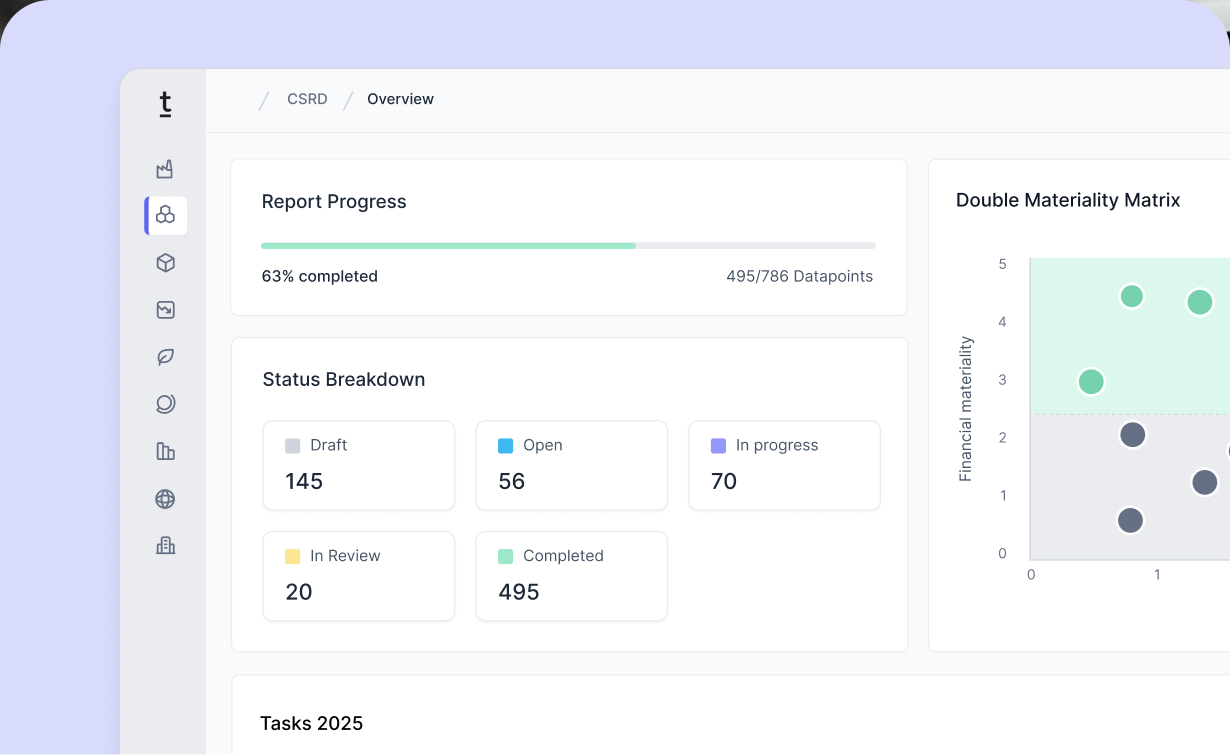
With increasing regulatory pressure – such as the CSRD – the expectations for ESG data are changing fundamentally. It is no longer just about numbers, but about their traceability.
Dr. Julia Koch, Sustainability Manager at ASSMANN, explains what professional software enables: „Thanks to Tanso, we can clearly show which emission factors and values come from which databases. This helps us not only in external communication, but was also positively evaluated by the environmental auditor during the sustainability report review."
In Excel, auditability often means: separate folder structures, scattered documents, email attachments and manual linking between numbers and evidence. Traceability exists in the mind of the responsible person – not in the system.
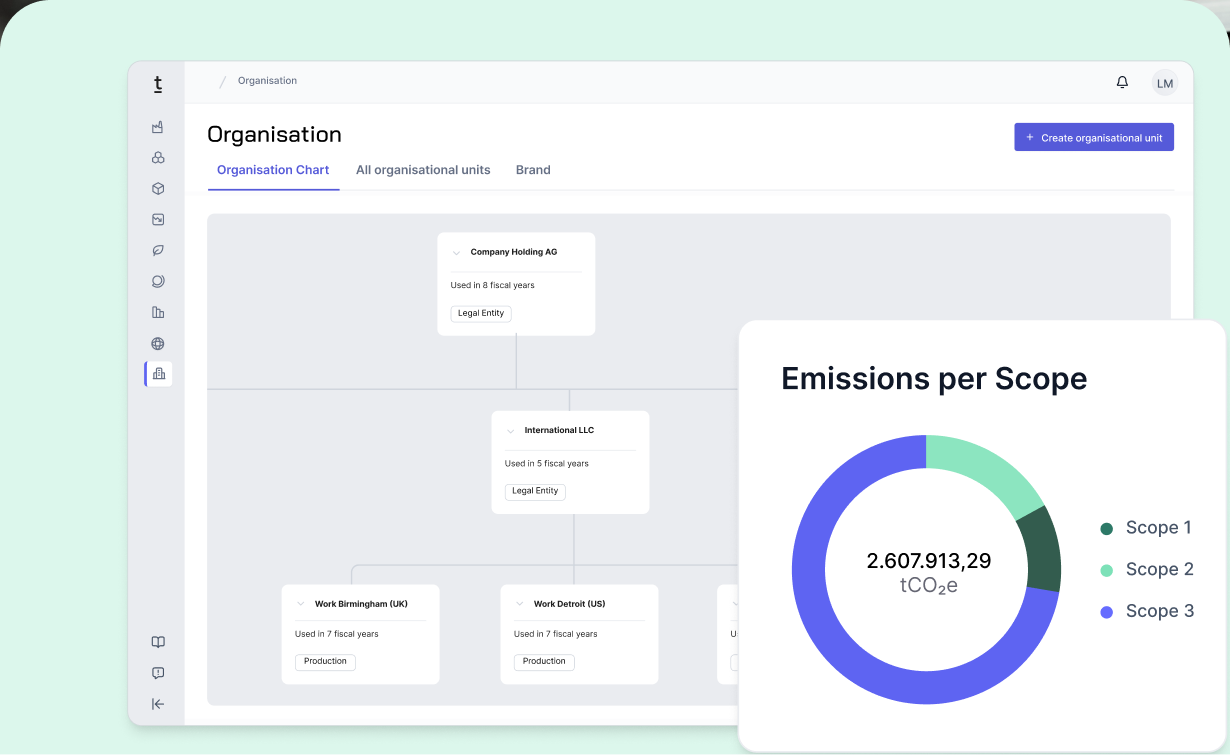
An ESG software platform, on the other hand, connects data points, emission factors, documents, and approval workflows directly. Audit trails are created automatically. Versioning is traceable. Changes are transparent.
In addition, regulatory updates – such as new disclosure requirements or reporting formats – can be systematically integrated. Instead of manually rebuilding reports, updates are maintained centrally and applied consistently.
For ESG managers, this reduces not only audit stress, but also personal liability concerns.
50% less effort - and what comes next
Before implementing dedicated software, many companies invest significant capacity in data collection alone. This effort is not due to a lack of commitment – but rather to manual coordination, follow-ups, and consolidation.
Heroal, a leading manufacturer of aluminum system solutions with over 800 employees and two production sites, reduced the time required for group-wide CO₂ calculation by 50% in just its second year of using Tanso’s ESG software.
A similar picture emerged at MAX Automation: at holding level, the effort was reduced by around 50%, and at individual subsidiaries by approximately 40%.
„Looking back at the early and extensive audit process, I am more convinced than ever that our decision to invest in a tool like Tanso in time was the right one – it gave us a solid data foundation," says Femerling.
But the biggest difference was not just time savings – it was process guidance: software provides structured guidance to employees, which accelerates workflows and reduces uncertainty at local sites.
ESG reporting is always a team effort. When data collection is structured, guided, and transparent, resistance in plants and departments decreases. Excel, by contrast, often creates uncertainty – because requirements are unclear, versions are inconsistent, and plausibility checks are subjective.
From Excel file to ESG infrastructure
Sustainability data is no longer just about reporting – it is the foundation for strategic decision-making, hotspot analysis, and prioritizing reduction measures.
Excel typically ends at aggregating numbers. ESG software, by contrast, enables the allocation of emissions to their actual sources, systematic deep-dives into Scope 3, and the integration of CO₂ data into business decision-making. At the same time, external emission factor databases and regulatory requirements are continuously updated, ensuring methodological compliance even as standards and regulations evolve.
Companies no longer need to manually adjust their reporting with every update to CSRD, ESRS, or industry-specific requirements. ESG evolves from an annual reporting task into a continuous and reliable management discipline.
Modern ESG software goes even further: with AI-supported features, companies can reuse data, identify connections between standards, and automatically generate suggestions for mappings or missing data.
This reduces manual effort and creates synergies across different reporting requirements – for example, when the same data points are used for CSRD, voluntary frameworks, and customer requests.
Excel is the beginning. But not the future.
Excel is not a mistake. It is a starting point.
But when decentralized data collection becomes overwhelming, emission factors need to be maintained manually, inconsistencies are only detected through experience, and audits are approaching, it becomes clear: Spreadsheets are not a sustainable foundation for modern ESG reporting.
A professional ESG software platform creates structure, traceability, and scalability. It reduces error risks, saves time, relieves teams, and makes sustainability data manageable.
Or put simply: Excel stores numbers. ESG software creates control, structure – and readiness for an evolving regulatory landscape.
And that is becoming a decisive competitive advantage in the context of regulation, carbon accounting, and growing customer pressure.



























.avif)


.jpg)
.jpg)


-p-800.webp.avif)
-min-p-800.webp.avif)





-p-800.webp.avif)

