


CSRD: How to correctly calculate the number of employees


Is there a standard EU method of calculating the number of employees?
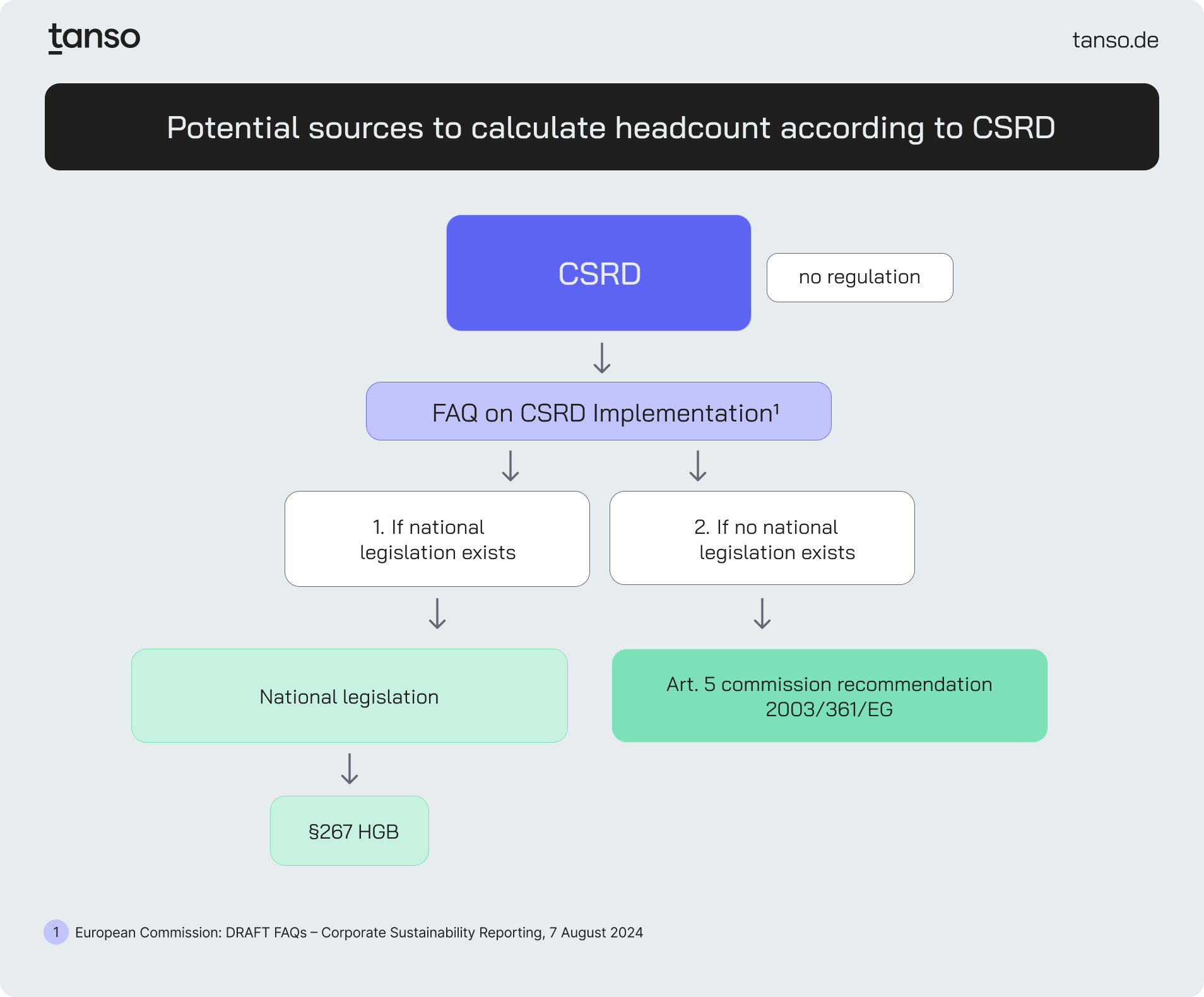
No. The EU does not mandate a single method for calculating employee numbers. Instead, it refers to national legislation. If national rules are not available, companies can use Article 5 of the European Commission Recommendation 2003/361/EC as guidance.
What does the European Commission Recommendation 2003/361/EC (Article 5) say?
The recommendation of the EU Commission says: "The headcount corresponds to the number of annual work units (AWU), i.e. the number of persons who worked fulltime within the enterprise in question or on its behalf during the entire reference year under consideration."
The following applies:
- Part-time and seasonal workers are counted as fractions of an AWU
- The headcount includes:
(a) Employees;
(b) Persons subordinated to the company and regarded as employees under national law;
(c) Managing partners;
(d) Partners regularly active in the company who derive financial benefits from it
- Not included are:
(a) Apprentices and interns with a training contract;
(b) Persons on maternity or parental leave
How is the number of employees calculated in Germany?
As the CSRD has not yet been transposed into German law (as of December 2025), there are currently no final, binding national guidelines for calculating the number of employees within the framework of the CSRD. However, a German government draft of the CSRD act was published on September 3, 2025, in which Art. 1 (6) refers to Section 267 (3) sentence 1 and (4) to (5) of the German Commercial Code (Handelsgesetzbuch, HGB). Section 267 (5) HGB, defines the average number of employees as “one quarter of the sum of the numbers of employees employed on March 31, June 30, September 30, and December 31, including employees employed abroad, but excluding those employed for vocational training.” Under German law, the number of employees is therefore calculated as a headcount – and not as AWUs (see also above) as recommended by the EU Commission.
Specifically, this means:
- The calculation is based on four key reference dates (see Haufe Online Redaktion: Wie die Zahl der Arbeitnehmer im Jahresdurchschnitt bestimmt wird)
- Employees working abroad are included
- Apprentices and members of the management board, managing directors, and supervisory board members are excluded from the count (see Haufe Online Redaktion: Zahl der beschäftigten Arbeitsnehmer)
Should companies count only employees based in the EU, or all global employees?
All employees worldwide must be taken into account when assessing CSRD thresholds.
Do employees of subsidiaries need to be counted proportionally (e.g., in the case of a 90% stake)?
It is advisable to include all employees of subsidiaries in full. The reasoning follows the logic of revenue consolidation under Section 296 of the German Commercial Code (HGB): if a subsidiary is material to group revenue and fully consolidated in financial reporting, it should also be fully reflected in CSRD-related non-financial reporting.
Employee calculation of seasonal businesses in Germany
According to Haufe Online, for seasonal businesses, calculating the average number of employees based on month-end headcounts is advisable in order to avoid distortions. This means that instead of using the statutory quarterly method pursuant to § 267 (5) HGB, the employee figures at the end of each of the twelve months should be used to obtain a more accurate picture of the actual number of employees.
Should temporary agency workers be included in the number of employees?
Until the CSRD is fully transposed into German law (expected by the end of 2025), there is no definitive legal guidance on this point.
However, according to the EU Recommendation (2003/361/EC, Article 5), seasonal workers should be included on a pro-rata basis. This logic can reasonably be extended to temporary agency workers. Germany’s Supply Chain Due Diligence Act (LkSG) requires that agency workers be fully counted (i.e., one headcount per person) if they significantly contribute to the size of the company. This is the case when they have worked for the company for more than six months within a year. The most robust approach is likely a proportional calculation based on full-time equivalents (FTEs). When in doubt, it’s best to consult your auditor.
Overview of calculating the number of employees
Other articles that may be of interest to you
Stay up-to-date with news from Tanso.

























.avif)


.jpg)
.jpg)


-p-800.webp.avif)
-min-p-800.webp.avif)





-p-800.webp.avif)

