


The 5 best ESG reporting software solutions in 2026


With the CSRD, the EU is significantly expanding ESG reporting requirements and setting new standards for transparency and data quality. This is based on the ESRS, which ensures the comparability and verifiability of reports. Emissions along the value chain are particularly relevant: While Scope 1 and Scope 2 emissions are usually easy to record, Scope 3 emissions significantly exceed direct emissions in many industries. For companies, this means that their processes and ESG data must be scalable, audit-ready, and integrated. Choosing the right ESG reporting software thus becomes a strategic component.
Why companies rely on specialized ESG software
ESG reporting is no longer a voluntary sustainability initiative, but a central component of regulatory compliance in the EU. With the CSRD (Corporate Sustainability Reporting Directive), the reporting obligation has been extended to thousands of additional companies. The underlying ESRS standards define in detail which data must be disclosed and how it must be collected, documented, and audited.
In addition, supplementary guidelines such as the EU Taxonomy, the Supply Chain Due Diligence Act, the CBAM (Carbon Border Adjustment Mechanism), and, in the future, the VSME standard are bringing the ESG area more into focus for investors, authorities, and suppliers.
Challenges associated with manual ESG reporting
Today, creating an ESG report requires much more than simply collecting and evaluating individual key figures.
Without specialized software, companies quickly reach their limits:
- Time required: Manually collecting and reconciling ESG data from different departments and supply chains is extremely resource-intensive.
- Complexity of standards: The multitude of regulations (CSRD, ESRS, EU taxonomy, etc.) requires in-depth expertise and regular updates to the reporting logic.
- Traceability: Audit-proof documentation and transparent data origin (“audit trail”) are prerequisites for external assurance.
- Data integration: ESG-relevant information is often stored in different systems (ERP, HR, Procurement) and must be consistently merged.
- Error-prone: Manual spreadsheets significantly increase the risk of inconsistencies and incorrect calculations.
Advantages of ESG-Software
In order to meet increasing regulatory and organizational requirements, more and more companies are turning to specialized ESG software.
The most important advantages at a glance:
- Recurring time savings: Automated workflows reduce manual effort in data collection, validation, and reporting by up to 80%.
- Seamless data integration: Existing systems can be easily connected for centralized, automated ESG data collection.
- Standard-compliant ESG reporting: Regulatory requirements such as CSRD, ESRS, EU taxonomy, and GRI are automatically taken into account and kept up to date.
- AI-supported sustainability analysis: Identification of optimization potential in ESG data and targeted derivation of measures to improve performance
- Central data management: All ESG-relevant information is consistently bundled – for clarity and efficient collaboration across departments.
- Audit compliance: Standardized data structures and automated plausibility checks increase the quality and reliability of reports.
- Strategic management basis: Intelligent analyses and dashboards provide decision-makers with clear insights into ESG risks, opportunities, and progress.
The top 5 ESG software solutions overview
In view of growing regulatory requirements, choosing the right ESG software is becoming increasingly important from a strategic perspective. The following providers are among the leading ESG software solutions on the market.
1. Tanso
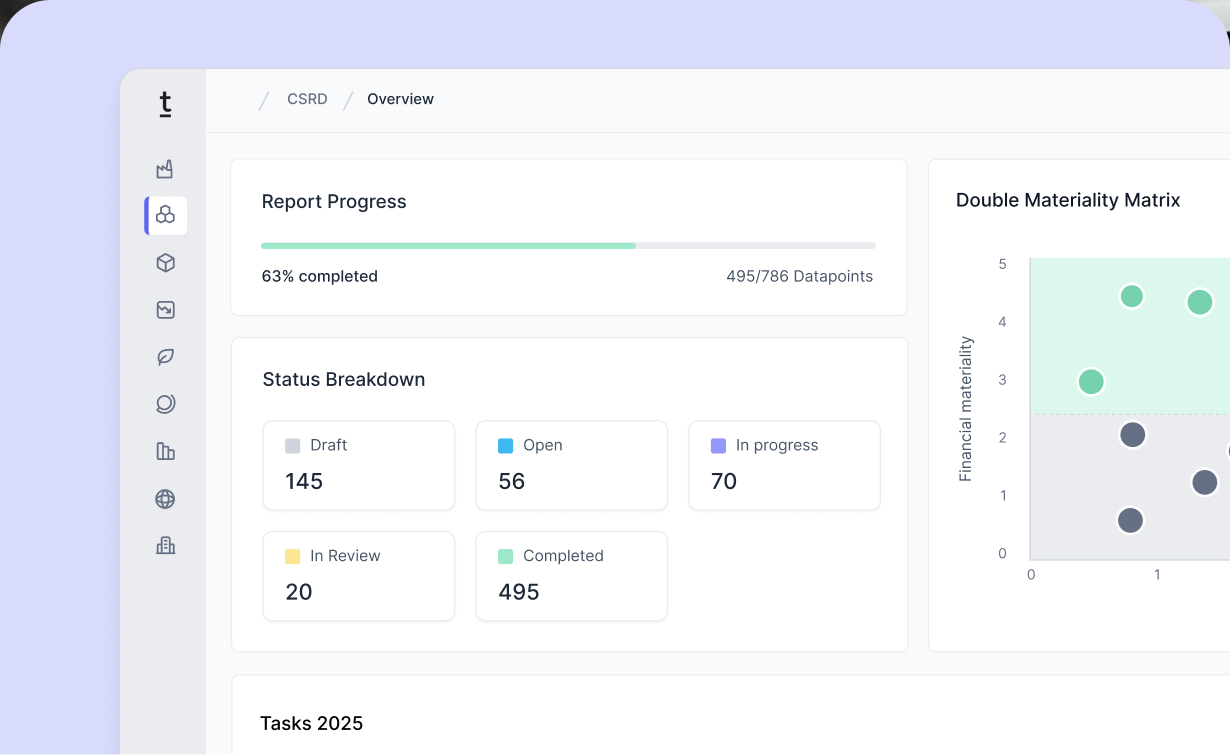
Tanso is a comprehensive ESG software platform that has been specially developed for medium-sized manufacturing companies and maps all CSRD, VSME, and EU taxonomy reporting requirements in a central environment. The solution combines AI-supported data management, complete regulatory coverage, and seamless system integration to create one of the most technologically advanced platforms on the market. In combination with the ISO-certified CCF and PCF modules, it meets all the requirements of modern sustainability software.
It is aimed in particular at manufacturing companies with high demands on data quality, traceability, and depth of integration, and enables company-wide, consistent, and auditable collection of ESG data—with a single source of truth for sustainability metrics along the entire value chain.
Key features:
- AI-based data management for automated collection, cleansing, and analysis of ESG and emissions data
- Seamless integration into existing IT landscapes, including SAP, Microsoft Dynamics 365, ProAlpha, and others
- Multi-reporting for CSRD, GRI, VSME, EU taxonomy, GRI, EcoVadis, CDP, and SAQ 5 – for efficient and consistent fulfillment of all ESG requirements
- Full traceability through audit trails for audit-proof ESG reports
- Seamless supplier integration for efficient and transparent ESG reporting along the supply chain via a supplier portal
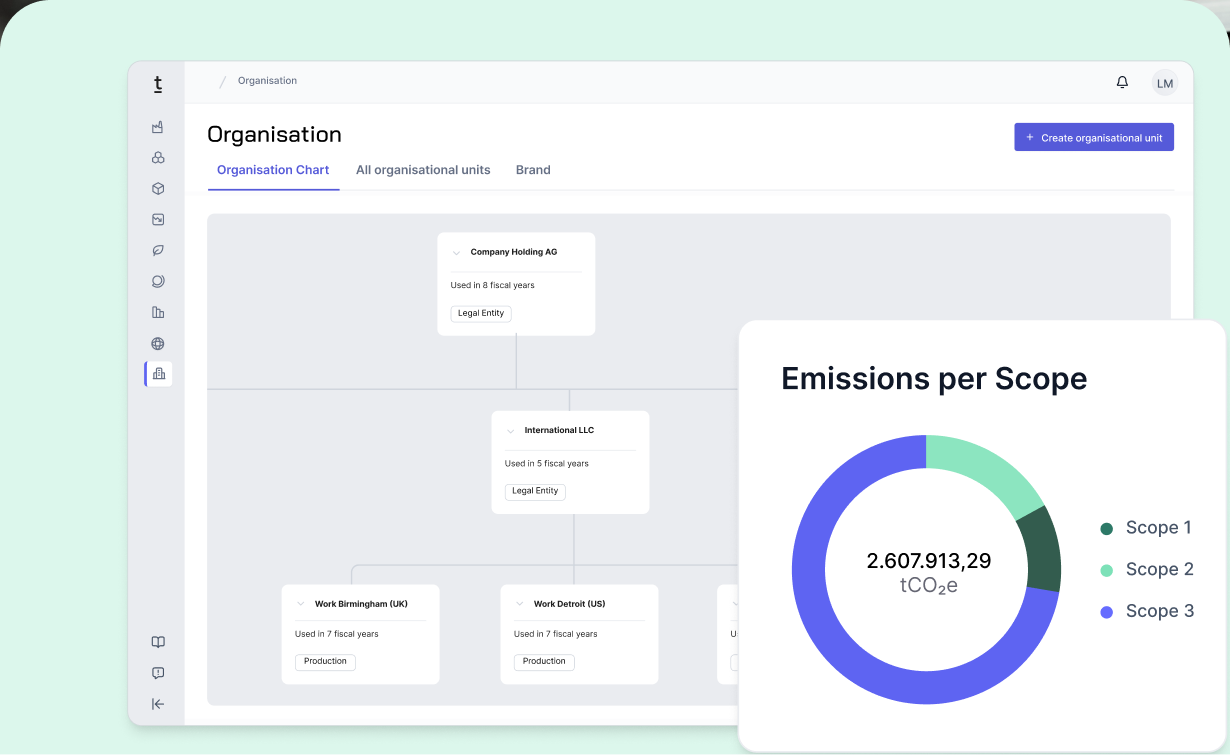
- Location-specific reporting with clear data allocation and consistent data structure across all organizational units
- Comprehensive analysis options in user- or user group-specific dashboards
- Company size: 65 employees (Source for company size: LinkedIn)
2. Leadity
Leadity is ESG and CO₂ management software that supports companies in planning, implementing, and reporting on their sustainability strategies. The platform includes features for materiality analysis, KPI tracking, CO₂ accounting, and compliance with regulatory standards such as CSRD, ESRS, GRI, and ZNU. The target group is medium-sized companies with established ESG processes that are looking for an integrated reporting solution.
Key features:
- ESG reporting in accordance with CSRD, ESRS, GRI, and ZNU with centralized data management
- Data exchange between modules is possible to a limited extent, but only partially automated
- Location-specific reporting with clear data allocation is possible to a limited extent
- Data import from ERP systems is partially automated
- Company size: 59 employees (Source for company size: LinkedIn)
3. Code Gaia
Code Gaia offers a cloud-based ESG software solution that focuses on automating data collection, analysis, and reporting. The platform enables centralized management of ESG and CO₂ data, supports common frameworks such as CSRD, ESRS, and EU taxonomy, and offers AI-powered data evaluation features. Its target group is small to medium-sized enterprises.
Key features:
- AI-supported processing and analysis of ESG and emissions data
- Data management with central cloud architecture
- No official API or ERP interface reported
- Data transfer between modules is partially integrated
- Company size: 59 employees (Source for company size: LinkedIn)
4. CONSUST
CONSUST is an ESG platform that combines software and consulting to help companies implement regulatory requirements such as CSRD, EU taxonomy, and supply chain legislation. The target group is companies that want to centralize and strategically manage their ESG data, including consulting components.
Key features:
- Combination of ESG software and consulting modules for CSRD, EU taxonomy, and supply chain law
- Central data collection and dashboard control for ESG strategy implementation
- Option to integrate external systems for data reconciliation and reporting
- Consulting-oriented approach with limited automation
- Company size: 11 employees (Source for company size: LinkedIn)
5. Lucanet ESG Reporting
Lucanet is expanding its financial reporting platform with an ESG module. The solution supports companies in the structured collection, validation, and disclosure of ESG information in accordance with standards such as CSRD and ESRS. The target group is companies with established financial and reporting structures that want to integrate ESG data into their existing financial module.
Key features:
- Expansion of the Lucanet financial platform to include ESG reporting in accordance with CSRD and ESRS
- Direct integration into existing financial and consolidation processes
- Excel upload function and data validation for structured disclosure
- No AI-based data management for automated data collection
- Company size: 896 employees (no information on team size in the ESG department)
With the right ESG software for sustainable corporate management
Suitable ESG software not only ensures that sustainability reporting complies with regulations, but also makes it strategically useful. It reduces manual effort, ensures verifiable data quality, and creates transparency along the entire value chain. For industrial companies in particular, the ability to automatically collect and validate data and integrate it into existing systems is becoming a decisive success factor.
Solutions such as Tanso show that specialized platforms offer clear advantages, especially for medium-sized manufacturing companies: they take into account complex supply chains, demanding CO₂ balances, and fully integrable ERP connections. This not only ensures that ESG is implemented efficiently, but also that it is used in a targeted manner to make informed decisions and mitigate risks.























.avif)


.jpg)
.jpg)


-p-800.webp.avif)
-min-p-800.webp.avif)





-p-800.webp.avif)

